Why Study in Australia? The Complete 2026 Guide for Indian Students
In a year when the USA is tightening student visas and Canada has cut international intake, Australia has emerged as the single most reliable destination for Indian students seeking a world-class degree, open work rights, and a realistic path to Permanent Residency.
Here is what makes Australia genuinely stand apart in 2026:
- 7 universities in the global QS top 100 — more than any other country except the USA and UK
- A Post-Study Work Visa giving graduates 2 to 6 years of unrestricted work rights
- One of the clearest PR pathways in the world for skilled graduates
- Over 700,000 Indian-born residents — a large, established community in every major city
- English-speaking — no language adjustment beyond accent
- A booming demand for skilled workers in IT, healthcare, engineering, and trades
- Three intake windows per year — February, July, and November — giving Indian students multiple entry points
Australia is not the cheapest destination. But when you factor in work rights during study, graduate salary potential, and PR opportunity, it consistently delivers among the highest returns on investment of any study-abroad destination.
Part 1: The Australian Education System
Australia’s higher education system is practical, research-driven, and internationally recognised across every industry. Key features Indian students appreciate:
- Application-based learning — not rote memorisation. Presentations, case studies, group projects, and lab work form the backbone of teaching
- Flexible course structure — students can choose electives and shape their academic path
- Strong industry connections — most universities have embedded internship and placement programmes
- CRICOS registration — every institution offering courses to international students is registered with the Commonwealth Register of Institutions and Courses for Overseas Students, guaranteeing quality standards
Degrees from Australian universities are recognised by employers and institutions across the Commonwealth, the USA, Europe, and Asia.
→ Deep dive: Understanding the Australian Education System for Indian Students
Part 2: Best Universities in Australia for Indian Students
Australia’s Group of Eight (Go8) universities are the most prestigious and globally recognised:
| University | Location | Global QS Rank | Strengths |
|---|---|---|---|
| University of Melbourne | Melbourne | Top 15 | Law, medicine, arts, science |
| Australian National University | Canberra | Top 30 | Research, policy, international relations |
| University of Sydney | Sydney | Top 20 | Business, engineering, medicine |
| UNSW Sydney | Sydney | Top 20 | Engineering, business, law |
| Monash University | Melbourne | Top 60 | Pharmacy, medicine, engineering |
| University of Queensland | Brisbane | Top 50 | Life sciences, sustainability, business |
| University of Adelaide | Adelaide | Top 100 | Engineering, agriculture — regional PR advantage |
| University of Western Australia | Perth | Top 100 | Mining, resources, marine sciences |
Beyond the Go8, universities like Macquarie, RMIT, Deakin, Curtin, and La Trobe offer strong career-focused programmes and are particularly popular with Indian students for their placement records and regional campuses.
→ Read more: Best Universities in Australia for International Students
→ Read more: Best Courses in Australia for a Successful Career in 2025
→ PR strategy: Unlock Your PR Pathway: Top Regional Universities in Australia
Part 3: Cost of Studying in Australia
Tuition Fees
| Degree Level | Annual Tuition (AUD) |
|---|---|
| Bachelor’s | AUD 20,000 – AUD 45,000 |
| Master’s by Coursework | AUD 22,000 – AUD 50,000 |
| Master’s by Research | AUD 18,000 – AUD 42,000 |
| PhD | AUD 18,000 – AUD 42,000 (many are fully funded) |
Living Costs
Australian living costs vary significantly by city. Across all IMFS student data and published guides, the realistic monthly budget is:
AUD 1,800 – AUD 3,000/month covering accommodation, food, transport, health insurance, and personal expenses.
- Sydney and Melbourne sit at the higher end (AUD 2,200–3,000)
- Brisbane, Adelaide, and Perth are mid-range (AUD 1,800–2,400)
- Regional cities and towns are the most affordable (AUD 1,400–1,800)
→ Full breakdown: Cost of Studying in Australia for Indian Students (2026)
→ Hidden costs: Top 10 Hidden Costs of Studying in Australia and How to Save Money
→ City-by-city: Living in Australia: Student Cost of Living Breakdown 2025
Scholarships for Indian Students in Australia
Studying in Australia need not mean paying full fees. Key scholarships available to Indian students:
- Australia Awards — fully funded, Government of Australia, highly competitive
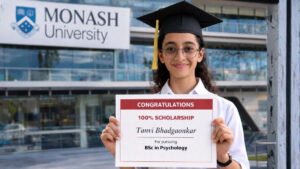
- Monash International Merit Scholarship — up to AUD 10,000/year
- Macquarie University India Scholarship — for UG and PG Indian applicants
- UNSW Future of Change Scholarship — tuition fee reductions
- ANU Chancellor’s International Scholarship — for high-achieving international students
- Destination Australia — government-funded scholarships specifically for regional study
→ Full guide: Financial Aid Options for Indian Students in Australia
Part 4: Australian Student Visa (Subclass 500)
Every international student in Australia requires a Student Visa (Subclass 500).
Key Requirements
- Confirmation of Enrolment (CoE) from a CRICOS-registered institution
- Genuine Temporary Entrant (GTE) statement — demonstrating your intent and connection to your home country
- English proficiency: IELTS 6.0–7.0 depending on the institution and course
- Proof of financial capacity — check the current requirement on the Department of Home Affairs website as this figure is updated annually
- Overseas Student Health Cover (OSHC) — mandatory for the full duration of your visa
- Health examination from an approved Australian panel physician
- Character requirements (police clearance may be required)
Work Rights on the Student Visa
- 48 hours per fortnight during study term
- Unlimited hours during scheduled university breaks
- Note: From July 2026, this is expected to increase to 60 hours per fortnight — check the Department of Home Affairs for the latest update
Visa Processing Time
Standard processing: 4–6 weeks. Apply at least 3–4 months before your intended start date, especially for the February intake when volumes are highest.
→ Step-by-step: Australian Student Visa: Step-by-Step Guide
→ Faster route: How to Secure an Australia Student Visa in 2026
→ Documents checklist: Documents Required to Study in Australia: Full Checklist (2026)
Part 5: Australia Intakes — When to Apply
Australian universities offer three intake windows:
| Intake | Start Month | Application Deadline | Best For |
|---|---|---|---|
| Semester 1 | February | October–November prior year | Most popular, widest course choice |
| Semester 2 | July | April–May same year | Aligns well with Indian academic calendar |
| Trimester 3 | November | August–September | Limited programmes, some universities only |
For Indian students completing 12th or graduation in May–June, the July intake is the natural fit. The February intake requires earlier planning but gives access to the most courses.
→ Full intake guide: Australia 2025 Intakes: Choose Right, Start Strong
Part 6: Post-Study Work Rights in Australia
This is where Australia truly excels. The Temporary Graduate Visa (Subclass 485) allows graduates to live and work in Australia with no restrictions on employer or occupation after completing their degree:
| Qualification | Work Rights (City) | Work Rights (Regional) |
|---|---|---|
| Bachelor’s degree | 2 years | 4 years |
| Bachelor’s (Honours) | 2 years | 4 years |
| Master’s by coursework | 3 years | 5 years |
| Master’s by research | 3 years | 5 years |
| Doctoral degree | 4 years | 6 years |
Regional study is a powerful multiplier — studying or working in a designated regional area adds up to 2 extra years of post-study work rights and significantly boosts your PR points score.
The Subclass 485 visa fee is approximately AUD 1,895 — factor this into your post-graduation budget.
→ Full guide: Post-Study Work Opportunities in Australia for International Students
→ Updated rules: Secure Your Future: Post-Study Work Rights in Australia 2026
→ Visa changes: Australia’s Work Visa Shake-Up in 2025: What You Need to Know Now
Part 7: Jobs & Careers in Australia After Graduation
Australia’s graduate job market is one of the strongest in the Asia-Pacific. The sectors with highest demand for international graduates in 2026:
- Information Technology — software engineers, data analysts, cloud architects, cybersecurity specialists
- Healthcare & Nursing — critical national shortage, direct PR pathway
- Engineering — civil, structural, mechanical, electrical
- Accounting & Finance — Big 4 firms, banking, financial services
- Education — teaching, early childhood (ECE), TESOL
- Construction & Trades — particularly in regional and infrastructure projects
→ In-demand roles: Top 5 In-Demand Jobs in Australia for Graduates (2026)
→ Skills that get PR: Top In-Demand Skills in Australia (Jobs, PR & Salaries – 2025)
→ Part-time work: Part-Time Jobs for International Students in Australia
→ Student jobs: Unlock a Thriving Future: 2026 Student Jobs in Australia
Part 8: PR Pathway — Staying in Australia After Graduation
Australia’s skilled migration system awards points based on age, qualification, English proficiency, work experience, and state nomination. The key PR visa streams for Indian graduates:
| Visa | Route | Minimum Points |
|---|---|---|
| Subclass 189 | Skilled Independent (no state sponsor needed) | 65 points |
| Subclass 190 | Skilled Nominated (state/territory nominates you) | 65 points + nomination |
| Subclass 491 | Regional Skilled (regional state nominates you) | 65 points + nomination |
Studying regionally is the fastest PR strategy — it gives bonus points (15 points for regional study/work) and regional states are more actively nominating Indian graduates in shortage occupations.
Courses aligned with the Medium and Long-term Strategic Skills List (MLTSSL) — nursing, engineering, IT, accounting — have the clearest PR pathways.
→ Regional PR strategy: Unlock Your PR Pathway: Top Regional Universities in Australia
→ Immigration update: Understanding Immigration Changes in Australia: 2025 Guide
Part 9: Best Cities in Australia for Indian Students
| City | Best For | Avg. Rent (Single Room/Week) | Indian Community |
|---|---|---|---|
| Sydney | Finance, tech, global HQs | AUD 300–500 | Very large |
| Melbourne | Education, arts, diversity | AUD 250–420 | Very large |
| Brisbane | Growing tech, sunshine | AUD 200–350 | Large |
| Perth | Mining, resources, lifestyle | AUD 180–320 | Growing |
| Adelaide | Healthcare, affordable, wine region | AUD 160–280 | Moderate |
| Canberra | ANU, government, research | AUD 200–320 | Moderate |
→ Full city guide: Top 10 Cities in Australia for Indian Students
→ Budget guide: Student Life Made Easy: Cheapest Cities in Australia 2025
→ State comparison: Discover the Best Australian States for Students
Part 10: Student Life in Australia — Everything You Need to Know
Accommodation
→ Accommodation Options for International Students in Australia
→ New to Australia? Avoid These Common Student Housing Cost Surprises
→ 10 Essential Tips for Thriving in Student Accommodation in Australia
Banking & Tax
→ Opening a Bank Account in Australia: A Guide for Indian Students
→ Getting a Tax File Number (TFN) in Australia for International Students
Transport
→ Getting an Australian Driver’s License for International Students
→ Public Transport and Travel in Australia: A Guide for International Students
Health & Safety
→ Healthcare and Insurance for International Students in Australia
→ Safety Tips for International Students in Australia
Culture & Apps
→ Life in Australia: Adjusting to Australian Culture and Social Life
→ Indian Students: How to Embrace Aussie Life & Culture
→ Best Apps for International Students in Australia
Part 11: Common Mistakes Indian Students Make in Australia
Knowing what not to do is as important as knowing what to do. The most common mistakes IMFS counsellors see:
- Choosing a university based on ranking alone, ignoring location and PR opportunity
- Underestimating living costs — budgeting AUD 1,200/month and running short
- Not applying for OSHC before the visa — this holds up the entire application
- Missing the GTE statement — a weak GTE is the #1 reason for visa rejection
- Not exploring regional universities despite the significant PR advantage
- Waiting until arrival to open a bank account and get a TFN — both can be set up in advance
→ Full list: Top 10 Mistakes Indian Students Make in Australia
FAQs — Studying in Australia for Indian Students
Q: Is IELTS mandatory for Australia? Most Australian universities require IELTS 6.0–7.0 for admission and the student visa. PTE Academic and TOEFL iBT are also widely accepted. Some universities offer English pathway programmes for students who don’t yet meet the threshold.
Q: Can I work while studying in Australia? Yes — 48 hours per fortnight during term and unlimited during scheduled breaks. This is typically enough to contribute meaningfully toward living costs. From July 2026, work rights are expected to increase to 60 hours per fortnight — confirm the latest on the Department of Home Affairs website.
Q: Which courses give the best PR outcome in Australia? Courses on Australia’s MLTSSL (Medium and Long-term Strategic Skills List) — including nursing, civil engineering, software engineering, accounting, and early childhood education — have the strongest PR outcomes. Studying regionally in one of these fields is currently the fastest pathway.
Q: How long does the Australia student visa take? Typically 4–6 weeks. Apply at least 3–4 months before your intended start date. February intake applicants should apply by October–November to avoid delays.
Q: Does IMFS help with Australia applications? Yes — IMFS provides end-to-end Australia counselling: university shortlisting, SOP and document preparation, scholarship identification, visa preparation, and pre-departure orientation. With a 99.8% visa success rate and 25+ years of experience, IMFS has guided thousands of students to Australia.
Start Your Australia Journey with IMFS
Australia offers Indian students something rare — world-class universities, genuine work rights, a large and welcoming Indian community, and one of the clearest PR pathways in the world. With IMFS guiding your application, the process becomes structured, clear, and stress-free.
👉 Book a Free Australia Counselling Session with IMFS →
Find your nearest IMFS branch for a free, walk-in counselling session:
| Branch | City | State |
|---|---|---|
| IMFS Dadar | Mumbai (Dadar) | Maharashtra |
| IMFS Churchgate | Mumbai (Churchgate) | Maharashtra |
| IMFS Borivali | Mumbai (Borivali) | Maharashtra |
| IMFS Vashi | Navi Mumbai | Maharashtra |
| IMFS Thane | Thane | Maharashtra |
| IMFS Shivaji Nagar | Pune | Maharashtra |
| IMFS Pimpri-Chinchwad | Pune | Maharashtra |
| IMFS Hyderabad | Hyderabad | Telangana |
| IMFS Kukatpally | Hyderabad | Telangana |
| IMFS LB Nagar | Hyderabad | Telangana |
| IMFS Madhapur | Hyderabad | Telangana |
| IMFS Warangal | Warangal | Telangana |
| IMFS Nellore | Nellore | Andhra Pradesh |
| IMFS Manipal | Manipal | Karnataka |
IMFS — Giving Wings to Your Dreams since 1997. 67,000+ students placed globally.