How to Study in USA from India: Complete Guide for Indian Students 2026
Planning to study in the USA from India? This 2026 guide explains the complete journey — choosing a university and programme, understanding admission requirements, planning your budget, applying for the F-1 student visa, understanding part-time work and OPT, and evaluating the long-term career and immigration picture.
Last reviewed: August 2026
Study in USA from India: 2026 at a Glance
India was the largest source of international students in the United States in 2024/25, with 363,019 students. The figure was up from 331,602 in 2023/24.
The numbers demonstrate the continued demand for U.S. education among Indian students, but popularity alone should not determine your destination. The right decision depends on programme fit, total investment, career potential and your tolerance for immigration uncertainty.
Why Study in USA?
The United States remains one of the world's major destinations for international education because students can choose from a large range of universities, programmes and academic specialisations.
Depending on the university and programme, students may combine classroom learning with research, internships, projects and other practical experiences.
Key reasons Indian students consider the USA
- A broad choice of universities and specialised programmes.
- Strong research opportunities at many universities.
- Access to major technology, finance, consulting, healthcare and research ecosystems.
- Opportunities for practical experience subject to immigration rules.
- Undergraduate, Master's and doctoral study options across disciplines.
- Potential access to OPT and, for qualifying STEM graduates, STEM OPT.
If you are comparing destinations before making a decision, explore the IMFS Study Abroad destination comparison resources .
Who Should Study in USA?
The USA is not automatically the best destination for every Indian student. Your financial position, academic objective and post-study plans should influence the decision.
USA can be a good fit if you:
- Have a clear academic or career objective.
- Want access to specialised programmes or research.
- Are targeting fields with strong U.S. employment ecosystems.
- Can fund the degree without depending on unauthorised or uncertain employment.
- Are comfortable with the uncertainty associated with post-study immigration.
Think twice if you:
- Need the lowest possible education cost.
- Depend heavily on part-time employment to fund tuition.
- Want a highly predictable PR pathway.
- Are choosing the USA only because of its reputation.
- Have not compared total investment with realistic career outcomes.
Study Options in USA for Indian Students
Indian students can pursue undergraduate, graduate and doctoral programmes in the USA. Programme duration and structure vary by university and field.
| Study Level | Typical Structure | Suitable For |
|---|---|---|
| Bachelor's | Usually around four years, depending on the programme. | Students applying after Class 12. |
| Master's | Often 1–2 years, depending on programme and university. | Graduates seeking specialisation or career advancement. |
| Doctorate | Usually several years, depending on discipline and research. | Students targeting research or academic careers. |
| Professional / Certificate Programmes | Varies significantly. | Students seeking focused academic or professional skills. |
Which level is right for you?
If you are applying immediately after Class 12, explore undergraduate programmes and check each university's academic and testing requirements. Graduates can evaluate Master's programmes based on specialisation, curriculum, research and career objectives. Students targeting academic or research careers may consider doctoral study.
How to Choose the Right US University
Rankings can help you build an initial shortlist, but they should not be the sole basis for choosing a university. A better approach is to evaluate the programme, total cost and expected career value together.
Evaluate these factors
- Programme curriculum and specialisation.
- Faculty and research areas.
- Internship and industry opportunities.
- Location and employment ecosystem.
- Tuition and living expenses.
- Scholarships, assistantships and funding.
- Admission requirements.
- Career services and alumni network.
- STEM designation where relevant.
- Programme-specific career outcomes.
USA Admission Process from India: Step by Step
A strong application starts well before the application deadline. Your exact process will vary by university and programme.
Define Your Academic Goal
Decide your intended degree, field, specialisation, preferred intake and approximate budget before beginning your university search.
Shortlist Universities and Programmes
Compare curriculum, admission requirements, tuition, location, funding opportunities, deadlines and career considerations.
Check Programme Requirements
Check the official university page for academic prerequisites, standardised tests, English proficiency, portfolio requirements and other programme-specific conditions.
Prepare Your Tests and Application Documents
Complete any required tests and begin preparing your transcripts, essays, SOP, recommendation letters, resume and portfolio where applicable.
Submit Applications Before Deadlines
Deadlines vary considerably. Some universities use multiple rounds, while others follow fixed deadlines. Always verify the current deadline on the university's official admissions page.
Evaluate Admission and Funding Offers
Compare the complete financial package, programme fit and career opportunity rather than choosing only on university ranking.
Accept the Offer and Obtain Form I-20
After accepting an eligible offer and completing the university's requirements, the institution can issue Form I-20 for the F-1 visa process.
Complete the F-1 Visa Process
Pay the required fees, complete the DS-160, follow the current appointment instructions and prepare for the visa interview.
SAT, GRE, GMAT and English Tests for USA Admissions
There is no single test requirement for all U.S. universities. Requirements can vary by university, programme and admission cycle.
| Test | Common Application Area | What You Should Check |
|---|---|---|
| SAT / ACT | Undergraduate admissions | Whether the university requires, recommends, accepts or does not consider the test. |
| GRE | Selected graduate programmes | Programme-specific GRE policy. |
| GMAT | Selected business and management programmes | Current programme requirements and accepted alternatives. |
| TOEFL / IELTS / PTE | English proficiency | Accepted tests, minimum scores and waiver conditions. |
Documents Required to Study in USA
Exact requirements vary by university and programme. The following documents are commonly relevant to the admission and visa stages.
Admission documents
- Academic transcripts and marksheets.
- Degree or school completion certificates, where applicable.
- Standardised test scores, if required or submitted.
- English proficiency score, if required.
- Statement of Purpose or programme-specific essays.
- Letters of Recommendation, where required.
- Resume/CV for relevant programmes.
- Portfolio for creative or design programmes, where required.
Visa-related documents
- Valid passport.
- Form I-20.
- DS-160 confirmation.
- SEVIS payment information.
- Visa appointment documentation.
- Financial evidence relevant to your case.
- Academic records and supporting documents.
Cost of Studying in USA for Indian Students
The cost of studying in the USA varies substantially depending on the university, programme, degree level, location and lifestyle. Tuition is only one component of the total investment.
For a detailed breakdown of tuition fees, accommodation, living expenses, financial aid and practical cost-planning considerations, read the dedicated IMFS guide: Cost of Studying in the USA: Tuition, Living, and More | IMFS .
| Expense | What Determines the Cost? | How to Plan |
|---|---|---|
| Tuition | University, programme and degree level. | Use the university's current published fee schedule. |
| Accommodation | City, campus housing and room type. | Compare university estimates with local housing options. |
| Food | Location and lifestyle. | Build a realistic monthly food budget. |
| Health Insurance | University policy and selected plan. | Check your university's mandatory insurance requirements. |
| Books and Supplies | Programme and course requirements. | Budget separately from tuition. |
| Transportation | City and campus location. | Check public transport and campus options. |
| Visa and Immigration Fees | Current government fees. | Verify fees immediately before payment. |
Do not build your education budget around part-time employment. F-1 employment is subject to specific rules and authorisation requirements. Your primary funding plan should be based on credible sources such as family funds, scholarships, assistantships and education loans.
Scholarships and Funding for Indian Students
Funding availability varies by university, programme, academic profile and application cycle. Students should investigate funding options before accepting an offer.
Common funding routes
- University merit scholarships.
- Need-based institutional aid where available.
- Graduate teaching assistantships.
- Graduate research assistantships.
- Departmental fellowships.
- External scholarships and fellowships.
- Education loans.
- Personal/family funding.
Is Studying in USA Worth the Cost?
This is one of the most important questions Indian students should ask before accepting a U.S. university offer.
A useful ROI model should consider the entire investment rather than tuition alone.
| ROI Factor | What to Evaluate |
|---|---|
| Total investment | Tuition + accommodation + food + insurance + travel + other university and immigration expenses. |
| Programme value | Curriculum, specialisation, research, projects and industry relevance. |
| Career opportunity | Employment ecosystem, location, skills and demand for your field. |
| Post-study work | Eligibility for OPT and, where applicable, STEM OPT. |
| Immigration uncertainty | H-1B and other employment-based pathways are separate from student status and are not guaranteed. |
| Debt burden | Compare expected repayment obligations against a realistic career outcome. |
Salary and Career Outcomes After Studying in USA
Salary outcomes vary significantly by occupation, industry, location, experience, degree and employer. Therefore, a university guide should not present a single “average salary after MS in USA” as though it were guaranteed.
U.S. Bureau of Labor Statistics data provides a more reliable benchmark by occupation. For example, May 2024 median annual pay was $133,080 for software developers, $112,590 for data scientists and approximately $101,910 for financial analysts.
| Occupation | U.S. Median Annual Pay | Important Qualification |
|---|---|---|
| Software Developers | $133,080 | BLS occupation-wide median; not a graduate starting-salary guarantee. |
| Data Scientists | $112,590 | Occupation-wide median; actual outcomes vary by profile and employer. |
| Financial Analysts | Approximately $101,910 | Occupation-wide median; not specific to international graduates. |
These figures should be used as broad occupational benchmarks rather than promises about what an Indian student will earn after graduation.
Career outcomes depend on the degree, technical and professional skills, internship experience, location, employer, prior experience and the wider labour market.
F-1 Student Visa Process for Indian Students
The F-1 visa is the standard student visa for eligible full-time academic study in the United States.
1. Receive Form I-20
After admission to an eligible institution and completion of the school's required process, the institution issues Form I-20 for the student visa process.
2. Pay the I-901 SEVIS Fee
The current I-901 SEVIS fee for F and M students is $350.
3. Complete the DS-160
Complete the online DS-160 nonimmigrant visa application and follow the current instructions applicable to applicants in India.
4. Pay the Visa Application Fee
The current non-petition-based nonimmigrant visa application fee, including the F student category, is $185.
5. Schedule the Required Appointment
Follow the current appointment and document instructions provided by the U.S. Embassy or Consulate handling your application.
6. Prepare for the Interview
Be prepared to explain your academic plan, university choice, programme fit, funding and post-study intentions accurately and consistently.
See the official U.S. Department of State student visa guidance for current requirements.
For current visa fees, refer to the U.S. Department of State visa fee schedule .
Important F-1 Visa Updates for 2026
U.S. student-visa applicants should check the latest government announcements immediately before applying because visa policies can change.
Expanded online-presence review
The U.S. Department of State states that F, M and J student and exchange visitor visa applicants are subject to online-presence review. Applicants are instructed to adjust the privacy settings of their social media profiles to “public” or “open” to facilitate this vetting.
Check the latest U.S. Department of State visa-screening announcement before submitting your application.
F-1 Visa Interview: What Should Indian Students Be Ready to Explain?
A visa interview is not a test for memorised answers. You should be able to explain your academic and financial plans clearly and truthfully.
Be prepared to discuss:
- Why you selected your programme.
- Why you selected that university.
- Why the USA is appropriate for your academic objective.
- How your previous education connects with the programme.
- How you plan to fund your education.
- Your expected career direction after the programme.
Can Indian Students Work Part-Time in USA?
F-1 students may have limited employment opportunities, but they cannot freely work in any job they choose. Employment must comply with the applicable F-1 rules.
On-campus employment
Eligible F-1 students may work on campus, and while school is in session they generally cannot work more than 20 hours per week.
Off-campus employment
Off-campus employment is not automatically permitted. Specific eligibility and authorisation requirements apply depending on the type of employment or practical training.
CPT and practical training
Curricular Practical Training (CPT) and Optional Practical Training (OPT) are forms of practical training connected to an F-1 student's field of study and are subject to specific eligibility and authorisation requirements.
Refer to the official DHS Study in the States employment guidance for current rules.
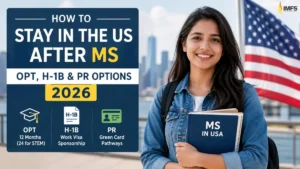
OPT and STEM OPT After Studying in USA
Optional Practical Training (OPT) allows eligible F-1 students to receive temporary employment authorisation for practical training directly related to their major.
| Route | General Period | Key Point |
|---|---|---|
| Post-completion OPT | Up to 12 months | Subject to F-1 eligibility, DSO recommendation and USCIS employment authorisation. |
| STEM OPT Extension | Additional 24 months | Available to qualifying F-1 students meeting the STEM OPT requirements. |
| Potential combined period | Up to 36 months | Applies where the student qualifies for both the initial OPT and STEM OPT extension. |
STEM OPT is not automatic for every STEM-labelled programme. The degree must meet the applicable requirements, and the student and employer must satisfy the relevant conditions.
See the official USCIS students and employment guidance for current information.
H-1B After OPT: What Indian Students Should Know
A possible career progression for an eligible graduate can involve moving from F-1 study to authorised practical training and potentially to another employment-based status.
A simplified pathway can look like:
| Stage | What It Means |
|---|---|
| F-1 | Student status for eligible academic study. |
| OPT | Temporary practical-training employment authorisation for eligible students. |
| STEM OPT | Possible additional 24-month extension for qualifying STEM graduates. |
| H-1B | Separate employment-based nonimmigrant classification subject to its own eligibility and, where applicable, cap/selection requirements. |
PR in USA After Study: The Reality for Indian Students
Studying in the USA does not create an automatic permanent-residence pathway.
It is important to distinguish between:
- F-1 status — student status.
- OPT — temporary practical-training employment authorisation.
- STEM OPT — additional practical-training period for qualifying STEM graduates.
- H-1B — separate employment-based nonimmigrant classification.
- Permanent residence — a separate immigration process.
Employment-based permanent residence can involve eligibility requirements, employer sponsorship and visa-number availability. Applicants chargeable to India can also face significant employment-based visa backlogs.
USA vs Other Study Destinations: What Should Indian Students Consider?
The right destination depends on the balance between cost, academic quality, career opportunity, work rights and immigration objectives. There is no universally best country.
| Factor | USA | What It Means for You |
|---|---|---|
| University choice | Very broad | Strong choice for students seeking specialised programmes. |
| Cost | Often high | Financial planning is critical. |
| Part-time work | Restricted under F-1 rules | Do not depend on casual employment to fund tuition. |
| Post-study work | OPT / STEM OPT framework | Attractive for eligible students, but subject to immigration rules. |
| PR | Not guaranteed | Long-term immigration should be treated as a separate decision. |
For a broader comparison of USA, Germany, Canada, Australia, UK, Ireland and New Zealand, see the IMFS Study Abroad destination comparison .
USA Application Timeline for Indian Students
A practical planning window is approximately 12–18 months before your intended intake. The exact timeline depends on your programme and university deadlines.
Pre-Departure Checklist for Indian Students
- Confirm university enrolment and orientation requirements.
- Arrange accommodation.
- Review university health-insurance requirements.
- Organise passport, visa and Form I-20 documents.
- Arrange travel and arrival plans.
- Prepare copies of important academic and financial documents.
- Understand local transportation and campus facilities.
- Review banking and mobile-connectivity arrangements.
- Attend the university's orientation where required.
Common Mistakes Indian Students Should Avoid
- Choosing a university only by ranking. Programme fit and ROI matter.
- Assuming every university requires GRE or SAT. Requirements vary by institution and programme.
- Depending on part-time income to fund tuition. F-1 employment opportunities are restricted.
- Using a generic SOP. Your application should demonstrate programme-specific fit.
- Ignoring the complete cost. Tuition is only one part of the investment.
- Treating OPT as a job guarantee. OPT provides employment authorisation subject to the applicable requirements; it does not guarantee employment.
- Assuming STEM automatically means PR. STEM OPT and permanent immigration are separate.
- Assuming OPT automatically leads to H-1B. H-1B has separate requirements and, where applicable, selection procedures.
- Using outdated visa information. Check current U.S. government guidance before applying.
- Failing to calculate debt and repayment risk. Compare your expected investment against realistic career outcomes.
Is USA Right for You?
The USA is strongest for students who can combine academic ambition with realistic financial planning and a clear career strategy.
Choose USA when your priorities are:
- Strong academic and research opportunities.
- Specialised programmes.
- Access to a large professional ecosystem.
- Potential OPT/STEM OPT after eligible study.
- Global career exposure.
Reconsider USA when your priorities are:
- Lowest possible total cost.
- Heavy dependence on part-time income.
- A predictable PR pathway.
- Choosing a destination mainly because it is popular.
- High education debt without a realistic repayment plan.
Related IMFS USA Resources
Frequently Asked Questions About Studying in USA
How much does it cost to study in USA from India?
There is no single cost because tuition and living expenses vary by university, programme, degree level and city. Students should calculate tuition, accommodation, food, insurance, transportation, books, travel and immigration expenses before accepting an offer.
Which visa do Indian students need to study in USA?
The F-1 visa is the standard student visa for eligible academic study at a U.S. university or college.
How much is the F-1 visa application fee?
The current non-petition-based nonimmigrant visa application fee for F student visas is $185. F and M students also pay the $350 I-901 SEVIS fee.
Can Indian students work part-time while studying in USA?
Eligible F-1 students can generally work on campus up to 20 hours per week while school is in session. Off-campus employment is subject to separate eligibility and authorisation requirements.
Is GRE mandatory for MS in USA?
No. GRE requirements vary by university and programme. Some programmes require the GRE, some recommend it, while others may not use it in admissions decisions.
Is SAT mandatory for Bachelor's in USA?
Not universally. SAT and ACT policies differ across universities and admission cycles. Students should check the current requirements of each university before applying.
What documents are required to study in USA?
Requirements vary, but commonly include academic transcripts, test scores where applicable, English proficiency scores, essays or SOP, recommendation letters, resume/CV and passport. Visa applicants also need the documents required for the F-1 process, including Form I-20 and DS-160 documentation.
How long is OPT after studying in USA?
Eligible F-1 students may generally receive up to 12 months of post-completion OPT. Qualifying STEM graduates may be eligible for an additional 24-month STEM OPT extension.
What is STEM OPT?
STEM OPT is a 24-month extension available to eligible F-1 students who meet the applicable requirements for qualifying STEM degrees and employment.
Can OPT lead to H-1B?
OPT can provide a period of authorised practical training, during which an eligible graduate may seek qualifying employment. However, OPT does not guarantee H-1B sponsorship, selection or approval. H-1B is a separate immigration classification with its own requirements.
Does studying in USA guarantee PR?
No. A U.S. degree does not guarantee permanent residence. Employment- based immigration involves separate eligibility requirements, sponsorship where applicable and visa-number availability.
When should I start applying to US universities?
A practical planning window is approximately 12–18 months before your intended intake. This allows time for university research, tests, application documents, deadlines and visa preparation.
Is USA worth the cost for Indian students?
It can be, particularly for students targeting strong programmes, specialised skills, research and global career opportunities. The decision should be based on the complete cost, realistic career outcome, funding and your tolerance for post-study immigration uncertainty.
Is USA a good option for Indian students in 2026?
It can be a strong option, but it is not automatically the best option for every student. Academic fit, financial capacity, career goals, work rules and immigration uncertainty should all be considered before making the decision.
What is the current F-1 visa application fee?
The current non-petition-based nonimmigrant visa application fee for F-category student visas is $185. The I-901 SEVIS fee for F and M students is $350.
How early can an F-1 student visa be issued?
New F and M student visas can be issued up to 365 days before the programme start date. Students cannot enter the United States more than 30 days before the programme start date.
Planning to Study in USA?
Get personalised guidance on university shortlisting, admission strategy, test preparation, application planning, financial planning and F-1 visa preparation.
Book Free Counselling